Karelia: The Lost Scandinavia That Almost Didn't Become Russia
East of Finland, the forests and lakes do not suddenly stop feeling Nordic. Karelia and Kola sit on the same ancient shield as Scandinavia, but history pulled them east.
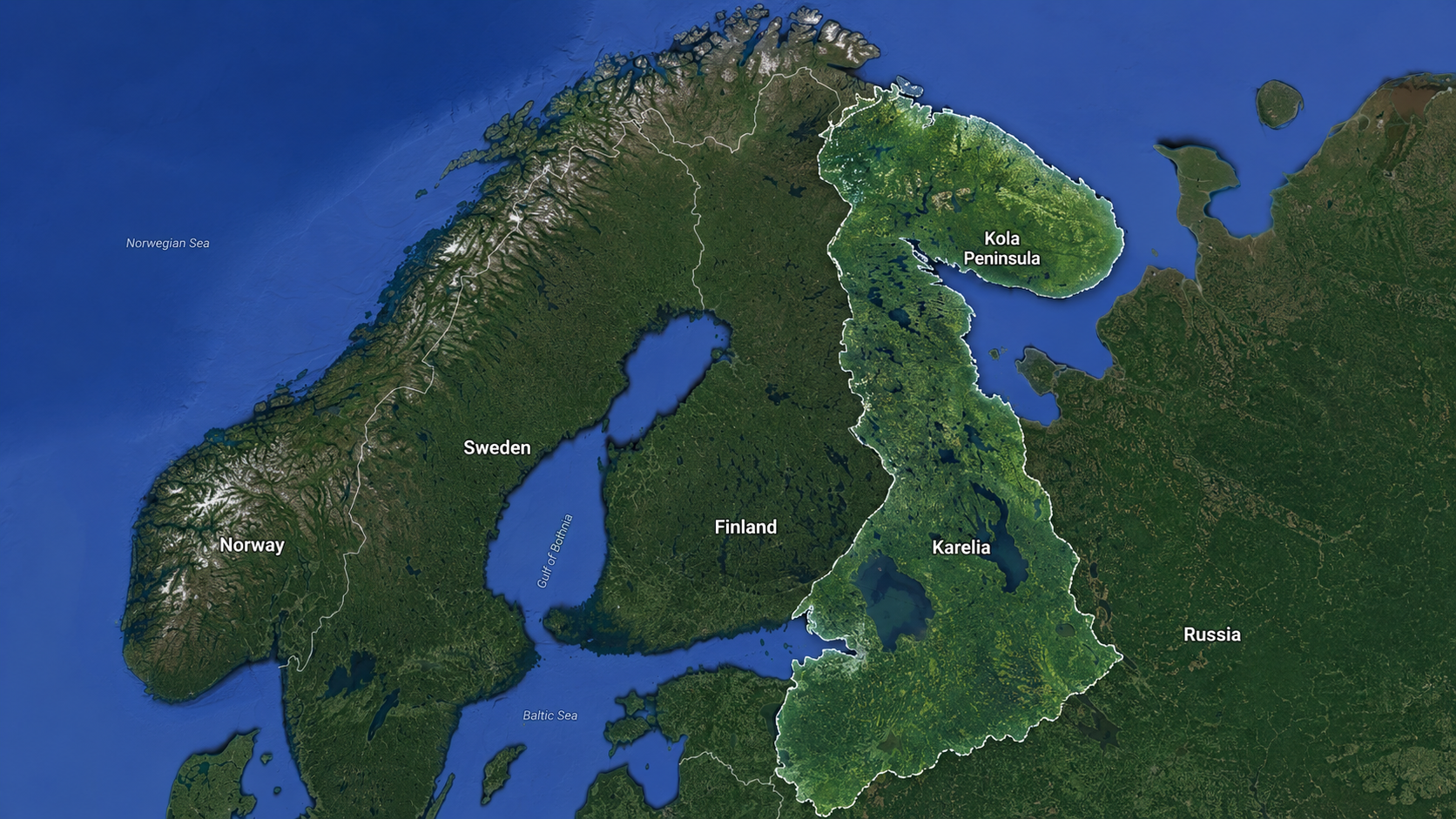
Step across the eastern border of Finland, and nature completely ignores the border guards.
The mirror-calm glacial lakes keep going. The smell of cold pine needles and wet granite doesn’t change. Three billion years of uninterrupted bedrock—the Fennoscandian Shield, which forms the geological spine of Norway, Sweden, and Finland—runs straight under your boots.
By every law of nature and geography, you are standing in Scandinavia’s twin.
Yet look at the watchtowers, the roadblock signs, and the Cyrillic alphabet stamped onto every building. You are in Russia.
This is Karelia and the Kola Peninsula: an Arctic corridor carved from the exact same raw timber as the world’s happiest countries, but hijacked by history and welded to an empire. It is a region where Finland’s national soul was secretly preserved, where wooden cathedrals were built without a single nail, and where a tranquil Nordic paradise quietly became the most heavily armed nuclear coastline on the planet.
The Stolen Heart of the World’s Happiest Nation
The supreme irony of the Nordic north is that modern Finland was not born in Helsinki. It was smuggled out of log cabins in the Russian wilderness.
In the 1830s, a rural country doctor named Elias Lönnrot strapped a canvas rucksack to his back and disappeared into the trackless forests of Russian Karelia. Centurylong Swedish rule had erased much of Finland’s indigenous oral traditions in the west, and Lönnrot was chasing a rumor: out past the Russian frontier, the old world was still singing.
He found it in rooms lit only by burning pine splints.
Illiterate Karelian peasants, sitting across from one another clasping hands, chanted epic verses that had been preserved entirely in human memory for over a millennium. Lönnrot feverishly wrote down their words, stitching them into the Kalevala—the mythic epic that gave Finns their national identity, spurred their fight for independence, and later became the blueprint for J.R.R. Tolkien’s Middle-earth.
“The folklore that built modern Nordic culture did not survive in the West. It was sheltered by villagers living under the Russian Tsar.”
The Medieval Knife That Sliced the Bedrock
The division that tore this land away from Scandinavia was settled not by culture, but by a ruthless medieval power play.
For centuries, indigenous Sámi herders and Finnic hunters lived without borders, running trade networks across frozen waterways. But by the 14th century, two expanding empires collided in the taiga: the Catholic Kingdom of Sweden pushing east, and the Slavic merchant Republic of Novgorod pushing west.
In 1323, they met on a fortress island and signed the Treaty of Nöteborg, carving the north in two:
- The West: Absorbed into the Swedish crown, inheriting the Latin alphabet, Lutheran egalitarianism, and the civil institutions that eventually birthed modern Scandinavian democracy.
- The East (Karelia): Handed to Novgorod and later swallowed by Moscow, inheriting the Cyrillic script, imperial serfdom, and autocracy.
Centuries of bloody tug-of-war followed. Sweden conquered it; Russia reclaimed it.
Between 1939 and 1944, Finland fought two brutal wars against the Soviet Union to hold it, only to be forced to cede over 10 percent of its industrial heartland. Hundreds of thousands of Karelians packed their lives into wooden carts and fled west, leaving their ancestral homes behind to be repopulated by Soviet settlers.
The Finnish future suggested by the landscape wasn’t just a fantasy; for generations of people, it was real life before the map was redrawn.
Where Onion Domes Replace Nordic Minimalism
Because Karelia was pulled east, it produced visual spectacles impossible anywhere else in northern Europe.
On the misty waters of Lake Onega sits Kizhi Island. Rising 120 feet above the reeds is the Church of the Transfiguration: a surreal wooden mountain crowned by 22 cascading onion domes. It was constructed entirely of notched Scots pine, fitted together so precisely that not a single iron nail was driven into the frame. It represents Scandinavian timber craftsmanship pushed to its absolute limit, yet warped into Russian religious mysticism.
Head further north onto the Kola Peninsula, however, and the fairy tale hardens into cold iron.
The high Arctic is normally a landscape of impassable ice. But the warm tip of the Atlantic Gulf Stream manages to graze the coast of Kola, keeping the harbor of Murmansk ice-free all winter long.
To Moscow, that ice-free harbor was worth any price in blood.
Instead of remaining a quiet Nordic wilderness of timber cabins and salmon rivers, Kola became the juggernaut of Soviet Arctic power. Today, Murmansk docks the world’s only civilian fleet of nuclear-powered icebreakers, while secret fiords along the peninsula shelter the ballistic missile submarines of the Russian Northern Fleet.
The Ghost in the Woods
Look at northern Europe today, and the dividing line is stark: on one side sits the world’s benchmark for human happiness, freedom, and stability; on the other sits an industrial, heavily militarized borderland.
Yet when you look at the raw land beneath the flags, the illusion breaks.
Karelia is the ghost of an alternate world. It is the sixth Scandinavian nation that never got to be—sitting in plain sight, trapped behind a border drawn with an ink pen seven centuries ago.